UNIT: - 02
ALGORITHM FOR PROBLEM SOLVING
02.01 Exchanging values of two variables.
02.02 Summation of a set of numbers.
02.03 Reversing digits of an integer.
02.04 GCD(Greatest Common Division) of two numbers.
02.05 Test whether a number is prime or not.
02.06 Organize numbers in ascending order.
02.07 Find square root of a number.
02.08 Factorial computation.
02.09 Fibonacci sequence.
02.10 Compute sine Series.
02.11 Check whether a given num is Palindrome
or not.
02.12 Find Square root of a quadratic
equation.
02.13 Multiplication of two matrices.
Q. What is an algorithm?
Answer: -
Algorithm
is a set step-by-step processor, which define a set of instructions to be
executed in a certain order to get the desired output.
1.
An
algorithm is a set of rules for carrying out calculation.
2.
It
is a sequence of computational steps that transform the input into the output.
02.01 Exchanging values of two variables.
Step-1 START
Step-2 Declare
variable a and b;
Step-3 Read
value ‘a’
Step-4 Read
value ‘b’
Step-5 temp=a;
Step-6 a=b;
Step-7 b=temp;
Step-8
Print the value of ‘a’ , ‘b’.
Step-9
END
PROGRAM: -
#include<stdio.h>
#include<conio.h>
void main()
{
int
a,b,temp;
printf("Enter
the value of a and b :-\n");
scanf("%d
%d",&a,&b);
printf("Before
Swapping a=%d, b=%d \n",a,b);
temp=a;
a=b;
b=temp;
printf("After
swapping a=%d, b=%d",a,b);
getch();
}

02.02 Summation of a set of numbers.(Sum of digits of given number)
Step-1 START
Step-2 Declare
variable n,m,sum=0;
Step-3 read
values n; n=m;
Step-4 while(n!=0)
{
rem=n%10;
sum=
sum + rem;
n=
n / 10;
}
Step-5 print
sum
Step-6 STOP
PROGRAM: -
#include<stdio.h>
#include<conio.h>
void main()
{
int
n,sum=0,rem,m;
printf("Enter
a num: -");
scanf("%d",&n);
m=n;
while(n
!= 0)
{
rem
= n % 10;
sum
= sum + rem;
n=n
/ 10;
}
printf("Sum
of %d num is %d",m,sum);
getch();
}

02.03 Reversing digits of an integer.
Step-1 START
Step-2 Declare
variable num, reverse =0;
Step-3 read
values num
Step-4 if(num
< 0)
{
printf
(“-“);
num
= -num;
}
Step-5 do
{
printf("%d", num % 10);
num = num / 10;
}
while(num
!=0);
Step-6 STOP
Note: - This algorithm is apply on both
negative and positive number.
PROGRAM: -
#include<stdio.h>
#include<conio.h>
void main()
{
long
int num;
printf("Enter a number: -");
scanf("%ld",&num);
printf("Reverse
of %d number is ",num);
if(num
< 0)
{
printf("-");
num
= -num;
}
do
{
printf("%ld",num%10);
num=num/10;
}while(num!=0);
getch();
}

02.04 GCD(Greatest Common Division) of two numbers.(HCF- Highest
Common Factor)
Step-1 START
Step-2 Declared
variables num1, num2, gcd, i;
Step-3 Read
values num1, num2;
Step-4 for(i=1; i <= num1 && i <= num2; ++i)
{
if(num1 %
i ==0 && num2 % i==0)
gcd = i;
}
Step-5 Display
gcd;
Step-6 STOP
PROGRAM: -
#include<stdio.h>
#include<conio.h>
void main()
{
int num1, num2, i, gcd;
printf("Enter two
integers: ");
scanf("%d %d",
&num1, &num2);
for(i=1; i <= num1
&& i <= num2; ++i)
{
if(num1 % i ==0 &&
num2 % i==0)
gcd = i;
}
printf("G.C.D of %d and
%d is %d", num1, num2, gcd);
getch();
}

02.05 Test whether a number is prime or not.
Step-1 START
Step-2 Declare
variables num, i, prime;
Step-3 Initialize
variables as
i
<- 2
prime
<- 1
Step-4 Take
input from user as num
Step-5 Repeat
the steps until i<(num/2)
Step-6 If
remainder of num % i = 0
6.1 Prime <- 0
goto step 7
6.2
i++ or i <- i + 1
Step-7 if
prime = 0
Display
num is not a prime number.
else
Display
num is a prime number.
Step-8 STOP
PROGRAM: -
#include<stdio.h>
#include<conio.h>
int main()
{
long int num;
int prime=1, i=2;
printf("Enter an integer:
");
scanf("%ld",
&num);
while(i<(num/2))
{
if(num%i==0)
prime=0;
i++;
}
if(prime==0)
printf("Number
%d is not a prime number",num);
else
printf("Number
%d is a prime number",num);
getch();
}

02.06 Organize numbers in ascending order.
In this algorithm we are taking three inputs from
user to arrange the input number into ascending order. For n numbers we have to
go for shorting algorithm i.e selection short and merge short.
Algorithm will upload as soon as possible
Algorithm will upload as soon as possible
PROGRAM: -
#include<stdio.h>
#include<conio.h>
int main()
{
int a[100],n,i,j,temp;
printf("enter array size [1-100] ");
scanf("%d",&n);
printf("enter %d integers ",n);
for(i=0;i<n;i++)
scanf("%d",&a[i]); /selection sort/
for(i=0;i<=n-2;i++)
{
for(j=i+1;j<=n-1;j++)
{
if(a[i]>a[j]) /this is ascending order/
{
temp=a[i]; a[i]=a[j]; a[j]=temp;
}
}
}
printf("sorted elements ");
for(i=0;i<n;i++)
printf("%4d",a[i]);
getch();
}
02.07 Find square root of a number.
In this we are using pre-defined
function sqrt() which belong to math.h header file: -
Step-1 START
Step-2 declare
variable n
Step-3 read
values of n from the user
Step-4 use
sqrt(n)
Step-5 print
<- sqrt(n);
Step-8 STOP
PROGRAM: -
#include<stdio.h>
#include<conio.h>
#include<math.h>
void main()
{
int n,m;
printf("Enter an integer: ");
scanf("%d",&n);
printf(“Square root of
%d is %.2f",n,sqrt(n));
getch();
}

02.08 Factorial computation.
Step-1 START
Step-2 Declare
variables num, temp;
Step-3 declare
one more variable as long fact
Step-4 initialize
fact<-1
Step-5 copy
num <- temp;
Step-6 while(num>=1)
{
fact=fact*num;
num--;
}
Step-7 display
the factorial i.e. fact
Step-8 STOP
PROGRAM: -
#include<stdio.h>
#include<conio.h>
void main()
{
int num,temp;
long fact=1;
printf("Enter an integer: ");
scanf("%d",&num);
temp=num;
while(num>=1)
{
fact=fact*num;
num--;
}
printf("%d
factorial is %d",temp,fact);
getch();
}

02.09 Fibonacci sequence.
Step-1 START
Step-2 Declare
variables num, f1, f2, f3
Step-3 initialize
f1 <- 0, f2 <- 1;
Step-4 read
values of num from user
Step-5 check
below condition: -
if(num
<=0)
printf("Series not
possible");
else if(num==0)
printf("0");
Step-6 before
displaying the series display 0, 1
Step-7 the
below loop is used to find the Fibonacci series
for(i=3;
i<=num; i++)
{
f3=f1+f2;
printf(",
%d",f3);
f1=f2;
f2=f3;
}
Step-8 STOP
PROGRAM: -
#include<stdio.h>
#include<conio.h>
void main()
{
int num,i,f1,f2,f3;
f1=0;
f2=1;
printf("Enter an integer: ");
scanf("%d",&num);
if(num <=0)
printf("Series
not possible");
else if(num==0)
printf("0");
else
{
printf("Series
is=0, 1");
for(i=3;
i<=num; i++)
{
f3=f1+f2;
printf(",
%d",f3);
f1=f2;
f2=f3;
}
}
getch();
}

02.10 Compute sine Series.
Sine Series:
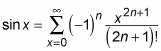
Series which is used to find the value of
Sin(x) is known as sine series.
In which, x is
the angle in degree i.e. converted into Radian.
The following formula is used to express the value of sin(x) as sine
series: -
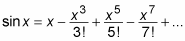
Expanding
the above notation, the formula of Sine Series is
For example,
Let the value of x be 30.
So, Radian value for 30 degree is 0.52359.
So, the value of Sin(30) is 0.5.
Step-1 START
Step-2 Declare
variables i, x, sum, t
Step-3 read
the values of x from the user
Step-4 Convert
x value into radian
x=x*3.14159/180;
Step-5 initialize
t <- x and sum <- x
Step-6 /* Loop to calculate the value of Sine */
for(i=1;i<=2;i++)
{
t=(t*(-1)*x*x)/(2*i*(2*i+1));
sum=sum+t;
}
Step-7 display
the sum as sin(x) values
Step-8 STOP
PROGRAM: -
#include<stdio.h>
#include<conio.h>
int main()
{
int i;
float x, sum, t;
printf(" Enter the value for x : ");
scanf("%f",&x);
x=x*3.14159/180;
t=x;
sum=x;
/* Loop to calculate the value of Sine */
for(i=1;i<=2;i++)
{
t=(t*(-1)*x*x)/(2*i*(2*i+1));
sum=sum+t;
}
printf(" The value of Sin(%f) = %.4f",x,sum);
getch();
}

02.11 Check whether a given num is Palindrome or not.
Step-1 START
Step-2 declares
variable num, m, rev and r;
Step-3 read
values of num from the user
Step-4 initialized
m <- n and rev <- 0
Step-5 while(num!=0)
{
r=num
% 10;
rev
= rev * 10 + r;
num = num / 10;
}
Step-6 if
(m== rev)
{
printf("The entered integer is a
palindrome");
}
Step-7 else
{
printf("The entered integer is not
a palindrome");
}
Step-8 STOP
PROGRAM: -
#include<stdio.h>
#include<conio.h>
void main()
{
long
num, m, rev=0;
int
r;
printf("Enter
an integer:");
scanf("%d",&num);
m=num;
while(num!=0)
{
r=num
% 10;
rev
= rev * 10 + r;
num
= num / 10;
}
if
(m== rev)
{
printf("The
%d integer is a palindrome", num);
}
else
{
printf("The
%d integer is not a palindrome", num);
}
getch();
}

02.12 Find Square root of a quadratic equation.
Step-1 START
Step-2 declare
variables a, b, and c
Step-3 read
values of a, b and c
Step-4 if
a =0 go to step-9
Step-5 calculate
value of discriminate=b*b – 4*a*c
Step-6 From
step-6 to step-8 we will find the nature of discriminate
if(discriminate
> 0)
{
root1 = (-b + sqrt(discriminate)) / (2*a);
root2 = (-b - sqrt(discriminate))
/ (2*a);
printf("Two distinct and real roots
exists: %.2f and %.2f", root1, root2);
}
Step-7 else
if(discriminate == 0)
{
root1 = root2 = -b / (2 * a);
printf("Two equal and real roots exists:
%.2f and %.2f", root1, root2);
}
Step-8 else if(discriminate < 0)
{
root1 = root2 = -b / (2
* a);
imaginary = sqrt(-discriminate)
/ (2 * a);
printf("Two
distinct complex roots exists: %.2f + i%.2f and %.2f i%.2f",
root1, imaginary,
root2, imaginary);
}
Step-9 STOP
PROGRAM: -
#include <stdio.h>
#include<conio.h>
#include <math.h> /* Used for sqrt() */
int main()
{
float a, b, c;
float root1, root2, imaginary;
float discriminate;
printf("Enter values of
a, b, c of quadratic equation (aX^2 + bX + c): ");
scanf("%f%f%f",
&a, &b, &c);
/* Find discriminate of the
equation */
discriminate = (b * b) - (4 *
a * c);
/* Find the nature of discriminate
*/
if(discriminate > 0)
{
root1 = (-b + sqrt(discriminate))
/ (2*a);
root2 = (-b - sqrt(discriminate))
/ (2*a);
printf("Two distinct and real roots
exists: %.2f and %.2f", root1, root2);
}
else if(discriminate == 0)
{
root1 = root2 = -b / (2 *
a);
printf("Two equal and
real roots exists: %.2f and %.2f", root1, root2);
}
else if(discriminate < 0)
{
root1 = root2 = -b / (2 *
a);
imaginary = sqrt(-discriminate)
/ (2 * a);
printf("Two distinct
complex roots exists: %.2f + i%.2f and %.2f - i%.2f",
root1, imaginary,
root2, imaginary);
}
getch();
}

02.13 Multiplication of two matrices.
Step-1 START
Step-2 declare
variables a[100][100], b[100][100], nr, nc, r, c, k;
Step-3 read
values of nr, nc, a[100], b[100][100] from users
Step-4 Use this for loop for performing matrix
multiplication
for(r=0;r<nr; r++)
{
for(c=0;c<nc; c++)
{
int s=0;
for(k=0;k<nr; k++)
{
s=s+a[r][k]*b[k][c];
}
printf("%4d",s);
}
printf("\n");
}
Step-5 STOP
PROGRAM: -
#include<stdio.h>
#include<conio.h>
int main()
{
int a[100][100], b[100][100],nr,nc,r, c, k;
printf("Enter Number of rows and columns of
matrix-a and matrix-b:-");
scanf("%d
%d",&nr,&nc);
printf("enter
%d integers for a - matrix ", nr*nc);
for(r=0;
r<nr; r++)
for(c=0;
c<nc;c++)
scanf("%d",&a[r][c]);
printf("enter
%d integers for b- matrix", nr*nc);
for(r=0;
r<nr; r++)
for(c=0;
c<nc;c++)
scanf("%d",&b[r][c]);
puts("
Multiplications of matrixes are: -");
for(r=0;r<nr;r++)
{
for(c=0;c<nc;c++)
{
int s=0;
for(k=0;k<nr;k++)
{
s=s+a[r][k]*b[k][c];
}
printf("%4d",s);
}
printf("\n");
}
getch();
}

{Other links
COA : -
OS
CPTC
NOTES of ISP (unit-4): -
NOTES of OS (unit-1): -
NOTES of OS (unit-2): -
}
FOLLOW US ON FACEBOOK:-



Nice sir,so helpful 🙂
ReplyDeleteYou welc dear, and all the best to you
ReplyDelete